
For Sale: One Slightly Used Trucking Company
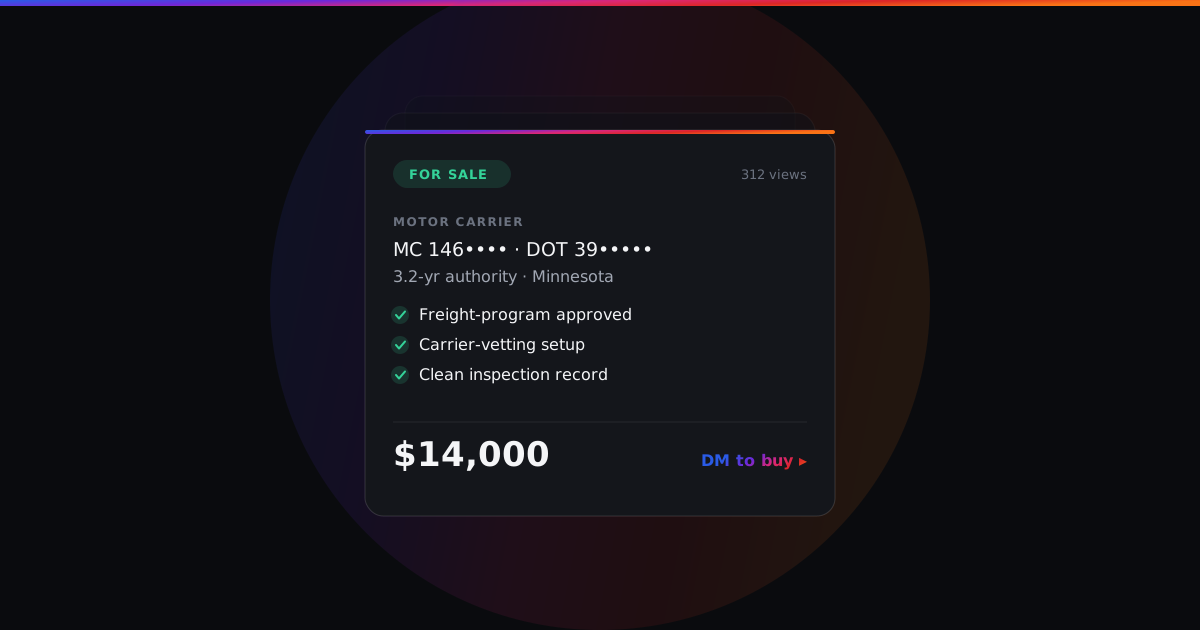
Somewhere on Facebook right now, a stranger is offering to sell you a federally licensed trucking company for about the price of a used pickup.
Inside the grey market for FMCSA operating authority
Somewhere on Facebook right now, a stranger is offering to sell you a federally licensed trucking company for about the price of a used pickup. Not the trucks — the company: its DOT number, its MC authority, and, if you're lucky, the clean inspection record and pre-approved freight-program access that came with it.
Here's the whole trick in one comparison: on a mainstream business marketplace, an operating trucking company sells for a median of $1.15 million — trucks, drivers, revenue and contracts included. On these channels, the paperwork alone goes for about $11,000. The grey market peels the single hardest-to-earn part of a trucking business — a seasoned, pre-vetted federal authority — off the company and sells it in isolation, at roughly 1% of the price of the real thing.
We scraped ~9,950 Facebook group posts, ~79,600 Telegram messages, and an entire online marketplace to map this grey market for the first time. After classifying which posts are genuine for-sale listings, we were left with 3,774 listings to analyze. Here's what the data says about how fast it's growing, what that shortcut costs, and what buyers are really paying for.
The one-line version: What's for sale isn't a truck: it's a regulatory shortcut. The authority changes hands for ~1% of a real business; the price is set by trust (one pre-approved by a major freight program sells for roughly double a plain one); and the "private sellers" flooding these channels are, in large part, a handful of dealer accounts wearing many names.
1. The market is formalizing — and accelerating
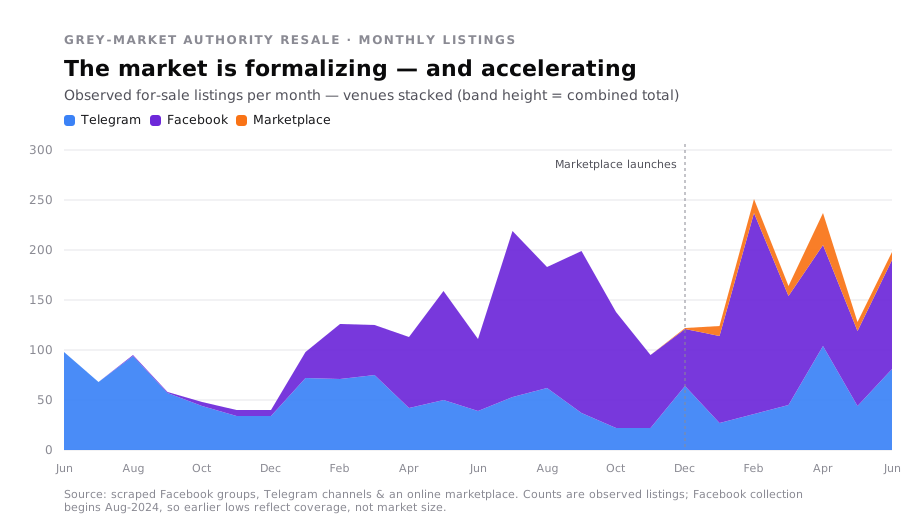
Two things jump out, and neither is the simplistic "it went from nothing to everything" story.
- Facebook has been a high-volume bazaar for over a year — routinely 100–200 for-sale posts a month through 2025 (peaking at 201 in February 2026). (The near-zero readings before late 2024 are an artifact of when our scraping began, not the true market size — we flag this honestly rather than claim a fake 20× surge.)
- The genuinely new development is formalization. A public, verified-seller marketplace for authorities launched in December 2025 and reached ~32 listings/month within four months. A grey market that lived in chat backchannels now has a storefront.
- Telegram runs hot too — a ~37/month baseline with a clear spring-2026 surge, peaking at 104 listings in April.
Takeaway: this isn't a fringe hustle anymore — it's an organizing market with its own dedicated marketplace.
2. Same product, three price tags
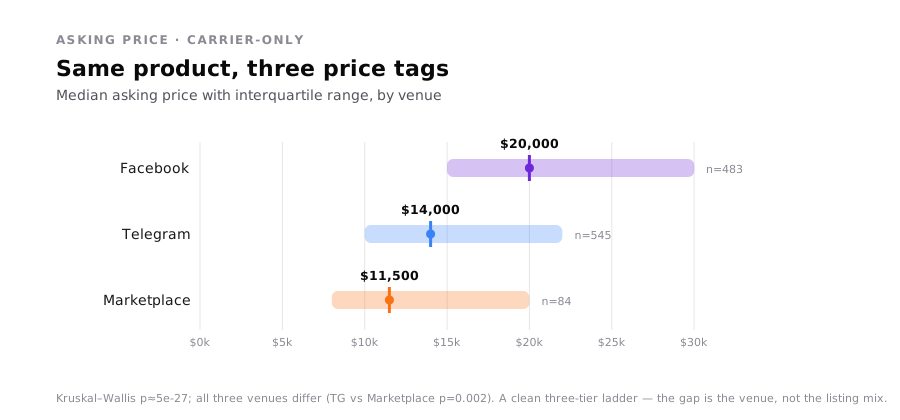
Where you shop changes the sticker price dramatically. Comparing carrier-only listings (apples to apples — no brokerages or fleets):
| Venue | Median ask | Middle 50% (IQR) | Listings |
|---|---|---|---|
| $20,000 | $15k–$30k | 483 | |
| Telegram | $14,000 | $10k–$22k | 545 |
| Marketplace | $11,500 | $8k–$20k | 84 |
The result is a clean three-tier ladder, and every rung is statistically distinct (Kruskal–Wallis p ≈ 5e‑27; even the closest pair, Telegram vs. the Marketplace, separates at p = 0.002). Facebook sits ~43% above Telegram and ~74% above the Marketplace — with the niche marketplace, not Telegram, now the cheapest venue.
Crucially, this is not a composition effect. We checked whether Facebook just has fancier listings (brokers, fleets) dragging the median up; it doesn't. Facebook carriers alone still ask $20k, and FB brokers only edge that to $25k. The premium is the venue and its audience: Facebook's groups are full of newer, less price-savvy buyers, and sellers price accordingly.
The 99% discount: you're buying the shortcut, not the business
We saw the headline up top; here's the distribution behind it. On a mainstream business-for-sale marketplace — where people sell actual operating trucking companies — asking prices cluster high: a median of $1.15 million, with 96% of 791 listings above $150k, because a listing there bundles trucks, drivers, revenue, contracts and goodwill.
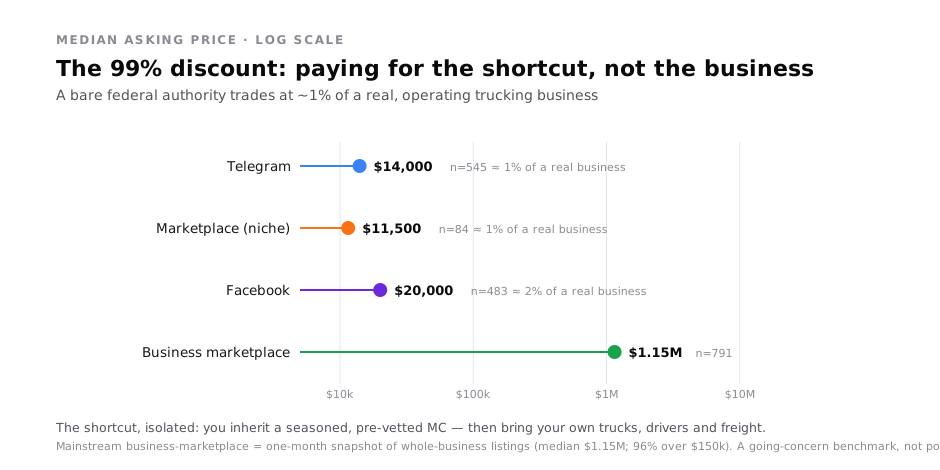
Against that, the grey channels sell at ~1% of the price (the niche marketplace and Telegram land near 1%; Facebook's pricier listings nearer 2%). But it isn't a discount on the same thing — it's the price of the regulatory shortcut, isolated. What changes hands is the hardest-to-earn, slowest-to-build piece of a trucking business: a seasoned, pre-vetted federal authority that's stripped of everything operational. You inherit the paperwork and the clean-ish record; you bring your own trucks, drivers and freight.
(This benchmark is a single-month snapshot with no listing-level classification, so we use it as a going-concern reference only — not pooled into the price, trust, or trend analyses.)
3. Buyers pay for trust, not trucks
This is the heart of it. The thing that moves price isn't the truck, it's third-party verification: signals that some outside party has already vetted the carrier. We grouped these into the signals listings actually advertise — an active approval from a major freight program, a carrier-vetting "setup," and a marketplace verified-seller badge — and priced each. (We keep the third parties unnamed throughout.)
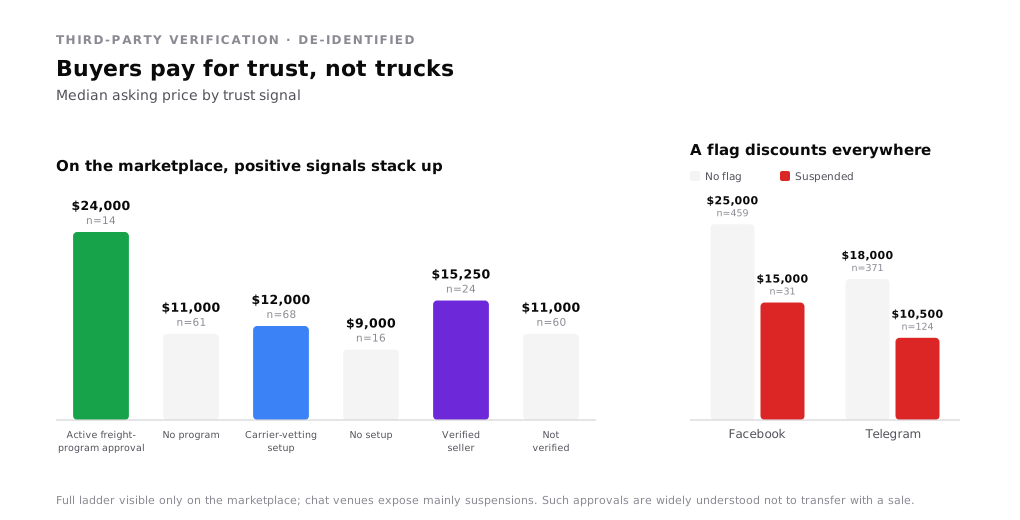
The single biggest lever is an active freight-program approval. On the marketplace — the only venue that cleanly labels every signal — a carrier with one asks a median $24,000 vs. $11,000 without: a +118% premium. A carrier-vetting setup points the same way (+33%).
The mirror image confirms the mechanism: a suspended / flagged third-party status discounts the authority — on Facebook $15k vs. $25k baseline, on Telegram $10.5k vs. $18k. Lose the relationship and you lose the premium. (On the chat venues this flagged status is mostly what surfaces; the marketplace is where the full positive ladder is visible.)
The catch buyers may be missing: these freight-program relationships are tied to the original entity and are widely understood not to transfer with a change of ownership. So the most valuable thing in this market may be access that doesn't actually survive the sale — a caveat worth putting front and center.
A note on why we don't report one combined "verified vs. not" number. We tried it. Aggregating all the trust signals into a single flag produces a backwards pooled result (verified listings look ~23% cheaper) — a textbook Simpson's paradox. Facebook dominates the pool, has the highest prices, and there a carrier-vetting setup is mostly a budget-tier headline: it's what a plain, newer, single-truck authority leads with when it has nothing pricier to advertise (an aged number, a fleet, an active program). So a verification signal genuinely adds value on the transactional venues but reads as a discount cue on Facebook, and a single pooled number hides exactly the thing that's interesting. The signal-by-signal view above is the honest one.
What about the federal license itself? The revocation that isn't a discount
The signals above are private (a freight program, a vetting service). The government has its own verdict: the FMCSA can revoke an operating authority (usually for an insurance lapse) and later reinstate it. You'd expect a revoked-and-reinstated authority — a license the feds once killed — to sell at a discount. We find no measurable one (though, as below, the priced cells are small enough that a modest discount can't be ruled out).
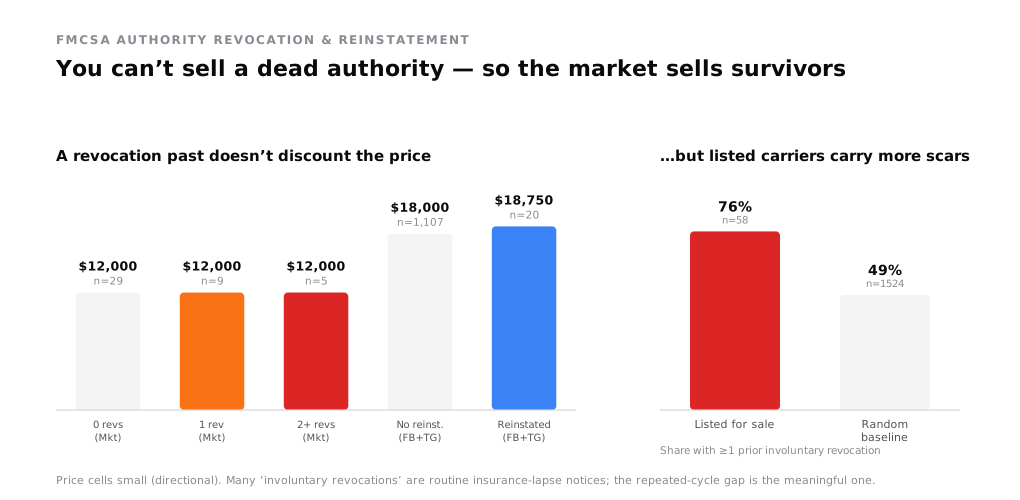
- On the marketplace, carriers with 0, 1, or 2+ prior revocations all ask the same ~$12,000. On Facebook/Telegram, listings that advertise a reinstatement ask $18,750 vs. $18,000 for those that don't — statistically a wash.
- Yet listed carriers are far more scarred than average. Matching for-sale DOT numbers to the FMCSA authority-history file, 76% have at least one prior involuntary revocation and 59% have two or more (median: 2). A random baseline sample of all carriers sits at 49% and 33% (median: 0).
The explanation is the punchline: you can't sell a dead authority. A revoked license can't be transferred, so by the time one reaches the market it's already been reinstated and is "active" again — and sellers frame the reinstatement as proof the paperwork is current, not as a black mark. The federal system's worst judgment becomes, in this market, a non-event.
(Caveats: many "involuntary revocations" are routine insurance-lapse notices that get discontinued once coverage is refiled, so "ever-revoked" overstates real misconduct — the repeated-cycles gap is the meaningful one. Price cells are small (n=20 reinstated, 43 with a known revocation count); the prevalence comparison is better powered (58 listed vs. 1,524 baseline) but only covers listings that disclose a DOT number.)
4. Supply surged, but the price held
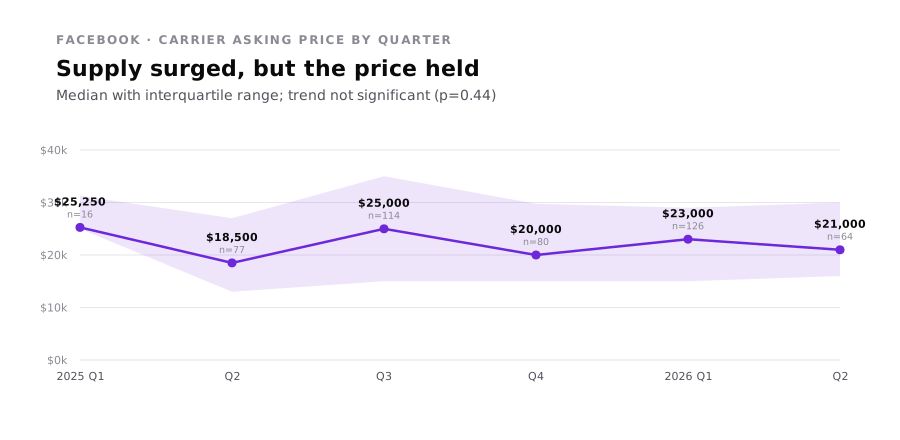
With listings flooding in, you'd expect prices to soften. They didn't. The Facebook carrier median has been stuck in an ~$18.5k–$25k band for six straight quarters. A regression of log-price on time finds no significant trend (slope ≈ +2%/quarter, p = 0.44). Supply ballooned; the going rate barely moved. A flat price against rising supply is consistent with demand keeping pace — though sticky asking prices and recycled, unsold inventory could produce the same picture.
(Facebook is the only source with enough priced listings per quarter to trend; Telegram and the marketplace are shown pooled for context only.)
5. What a listing actually looks like
Asking prices are disclosed by only a minority of posts (~31% on Facebook and Telegram, 100% on the marketplace — the marketplace forces a price field). When a seller does volunteer details, the typical listing is a small, single-truck authority advertising a third-party carrier-vetting "setup," with contact info gated behind a DM.
How old are the companies being flipped?
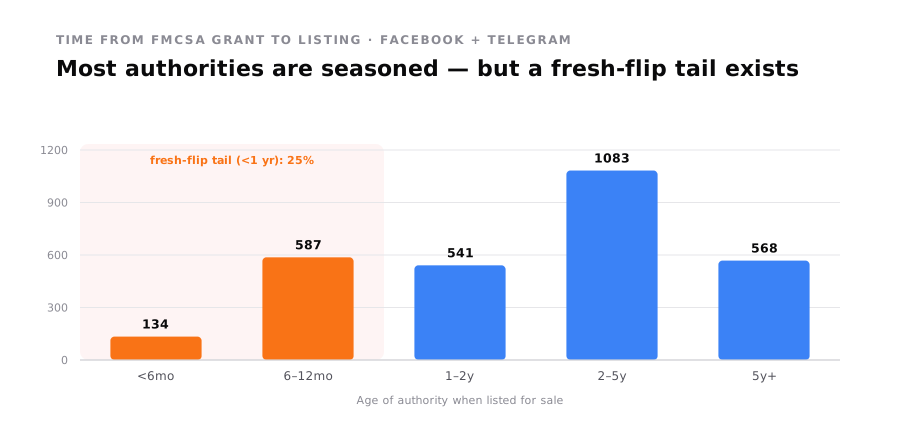
Most authorities for sale are seasoned — the bulk are 2+ years old, exactly what a buyer wanting an established record would want. But there's a real fresh-flip tail: 25% are listed within a year of being granted, and 5% within six months. We can't observe intent, but an authority offered for resale months after it was issued is hard to square with a genuine attempt to build a business.
Do sellers lie about the age? Mostly no. We joined a sample of listed DOT numbers to FMCSA's official authority-history records (35 matchable pairs — only the listings transparent enough to disclose a DOT): the median gap between the claimed grant date and the real one was just 46 days, and 74% were within a year. On age, at least, the claims roughly check out — a useful, slightly counterintuitive reality check for a "shady" market.
6. The dealers presenting as private sellers
Is this thousands of mom-and-pop operators each offloading one company? No. Supply is concentrated in a few hands.
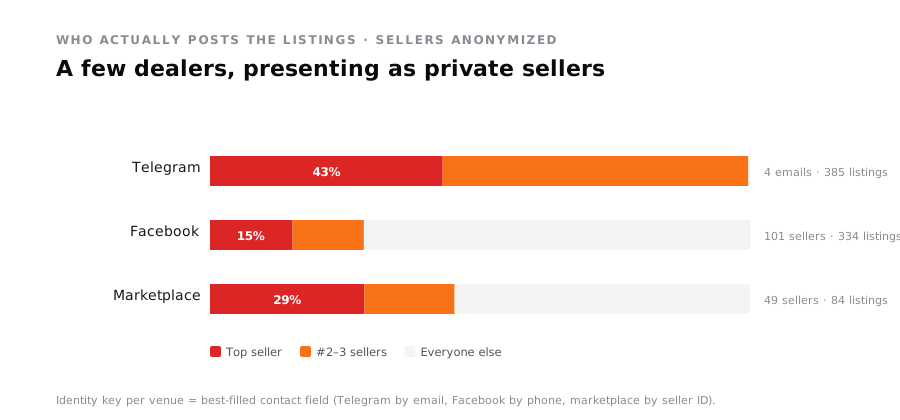
- Telegram: nearly every emailed listing — 384 of 385 — traces back to just four email addresses (really three: one alone accounts for 166, and the top three cover 99.7%).
- Facebook: the top seller's phone number appears on 51 listings; the top three sellers post ~28% of everything keyed to a phone.
- Marketplace: the single busiest seller holds 24 of 84 listings (29%).
A market that presents as countless independent owners is, underneath, a brokerage business run by a small number of professional flippers. (Sellers are anonymized here; we identify the pattern, not the people.)
7. The same companies, advertised over and over
Using the existing entity-resolution layer (which links posts across Facebook, Telegram, the marketplace, and a mainstream business marketplace to a single DOT number), we can see how often the same authority gets re-advertised.
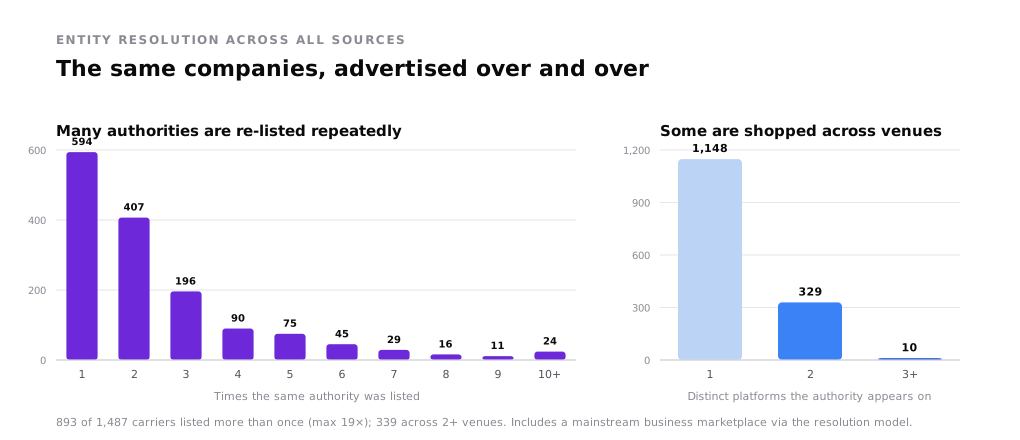
- 60% of carriers (893 of 1,487) appear in more than one listing — one was posted nineteen times.
- 339 carriers are shopped across two platforms, and a handful across three — the same company simultaneously on Facebook, Telegram, and the marketplace, often at different asking prices.
It's the same inventory, recycled and cross-posted until it sells.
Methodology & caveats
- Sources. Scraped Facebook groups, Telegram channels, and an online marketplace. Posts were LLM-classified; a row counts as a listing if it is marked for-sale or sold. Fields (price, age, freight-program status, etc.) were LLM-extracted from free text. A mainstream business-for-sale marketplace (a large public site, kept unnamed) is used two ways only: as the going-concern price benchmark in §2 (a one-month, unclassified snapshot, not pooled) and in the §7 cross-listing counts via the entity-resolution model.
- Asking ≠ transacted. All prices are asks, not sale prices. We report medians throughout and trim a handful of extreme/fleet outliers (e.g. a $13.5M brokerage) for distribution comparisons.
- Small samples. Priced listings number 586 (Telegram), 552 (Facebook) and 84 (marketplace); some sub-group cuts (program-approved, suspended) still fall to the low double digits. Every chart labels its n; treat small cells as directional.
- Self-reported & extraction error. Freight-program / carrier-vetting / safety claims are unverifiable seller assertions, and LLM extraction is imperfect. Where we could ground-truth (grant dates vs. FMCSA), claims held up reasonably well.
- Coverage, not census. These are observed listings. Facebook collection began Aug-2024, so early volume reflects coverage, not market size — which is why we don't claim a clean "1/month → 100/month" hockey stick.
- Why "grey." Selling an operating authority is not in itself illegal, but these transfers route around the FMCSA's new-entrant vetting and frequently carry freight-program access that is widely understood not to transfer with a change of ownership — a legal-but-against-the-rules zone. That is the sense in which we use "grey market."
- De-identification. Seller contact identifiers (phones, emails, account IDs) were used only to count and group listings; they are never published, and individual sellers appear as anonymized patterns. Exact per-seller counts are aggregate tallies, not pointers to any named account.