
What Moves the Price of a Trucking Authority

We pulled 1,605 for-sale listings of US motor carrier authorities (an MC/DOT number with its operating history) posted between January 2024 and October 2026 on Telegram, Facebook and a marketplace, and asked one question: what makes one authority ask $9,000 and another $28,000? The answer is mostly not what the carrier owns. It is what the authority has done.
The market doubled in two years
The median asking price for an authority was $7,000 in the first quarter of 2024 and $20,000 in the third quarter of 2026. Most of the climb happened in two steps: a jump to around $15,000 in early 2025, where it sat for six quarters, and a second move up in mid-2026.
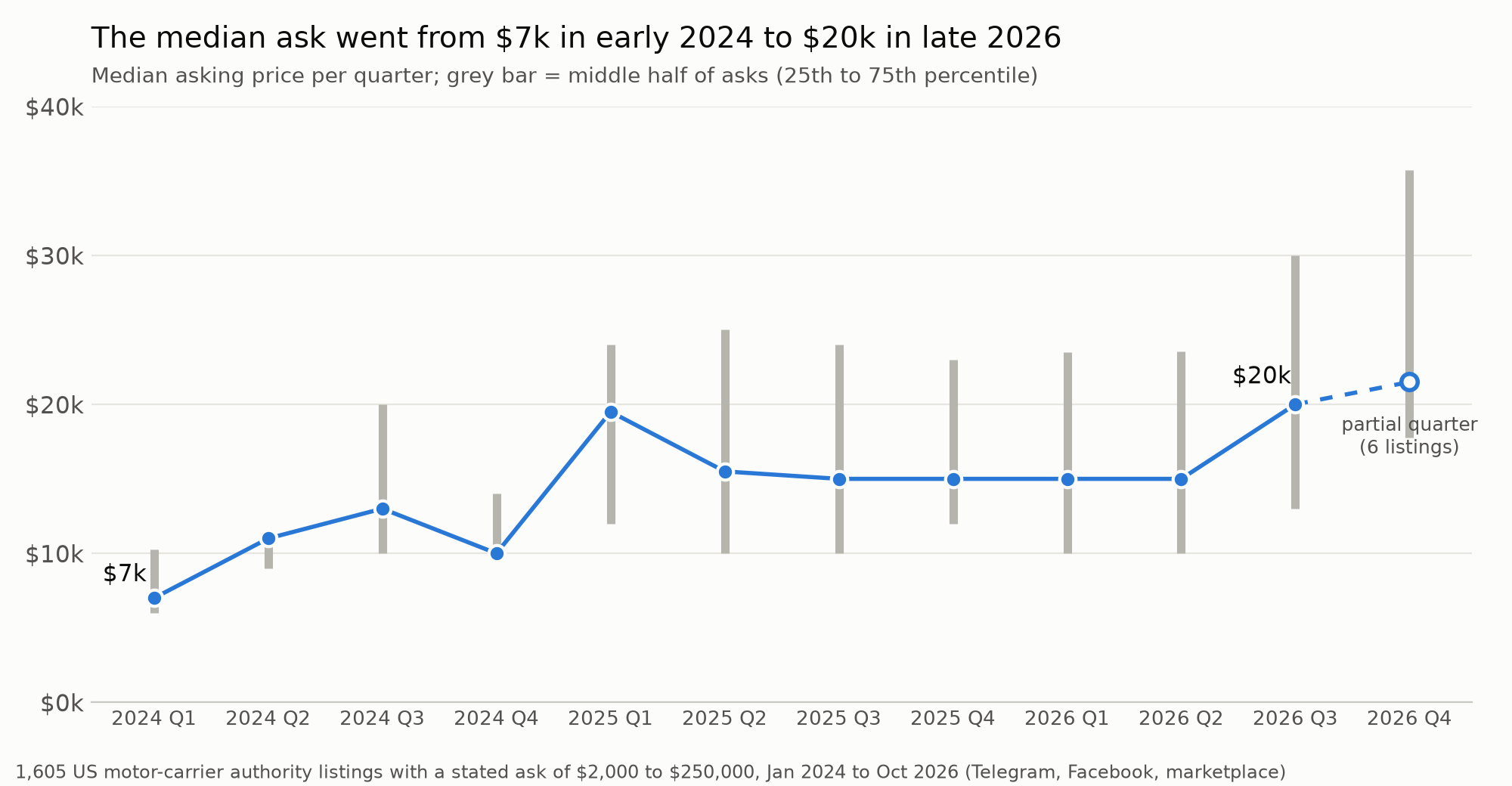
The rise is not a change in what is being sold. Holding the basket fixed to one- to three-year-old authorities without an Amazon account, the median went from $8,250 in early 2024 to $17,500 in late 2026. Plain authorities doubled. Amazon-live authorities of the same age, by contrast, have asked about $24,000 since 2025 and have not moved. The floor rose; the ceiling stayed put.
Amazon Relay status is the price
Nothing else comes close. An authority with a live Amazon Relay account asks a median of $24,000. One with no Amazon account asks $11,000. A suspended account asks $12,000, barely more than none at all.
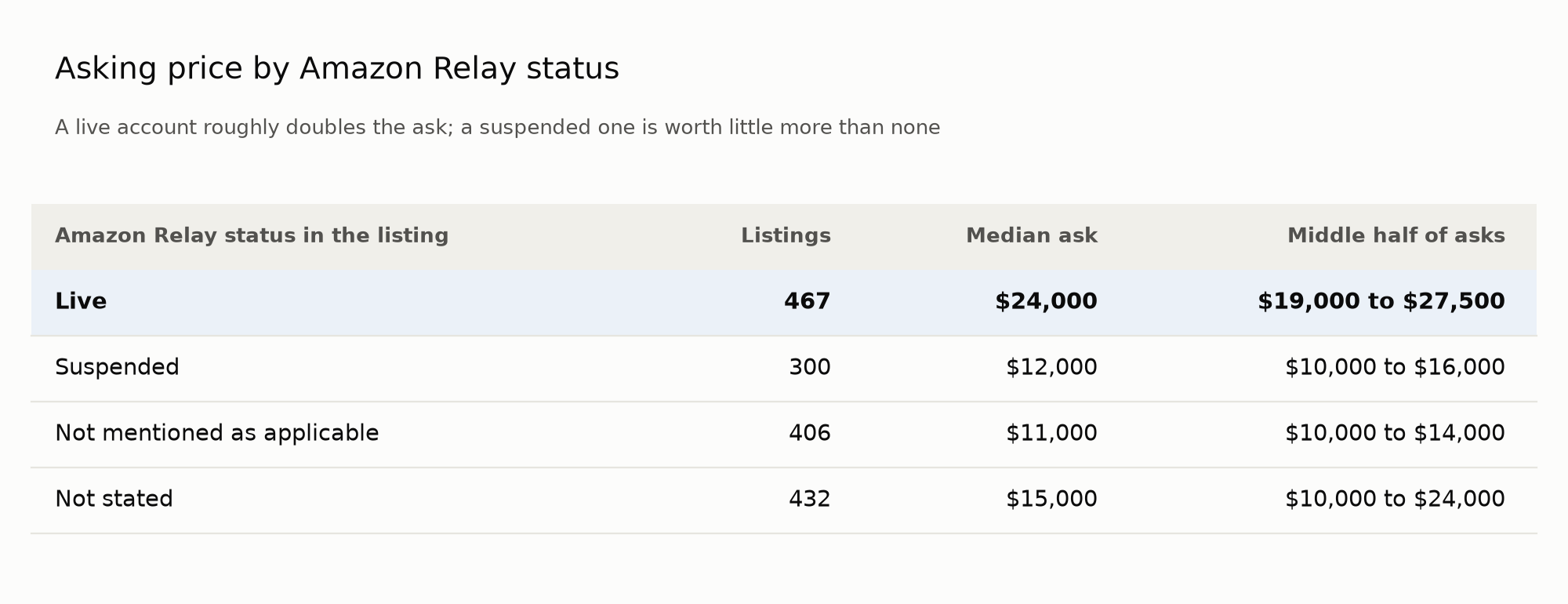
The reason is simple. A new carrier cannot get onto Amazon's load board until its authority has aged and passed checks, and accounts get suspended for safety and performance. Buying an authority with a live account buys the queue position. Sellers know it: the listings lead with the Amazon status before the age or the state.
The share of listings that are Amazon-live has fallen from about half in early 2025 to one in seven by late 2026. Fewer live accounts are reaching the market, and the ones that do have held their price while everything else rose toward them.
Age matters, but only without Amazon
Sellers lead with age ("MC 2.5 years old") and buyers pay for it. Across all listings the median ask climbs from $11,000 under one year to $20,500 past eight years. Holding everything else fixed, doubling the age adds about 11% to the ask.
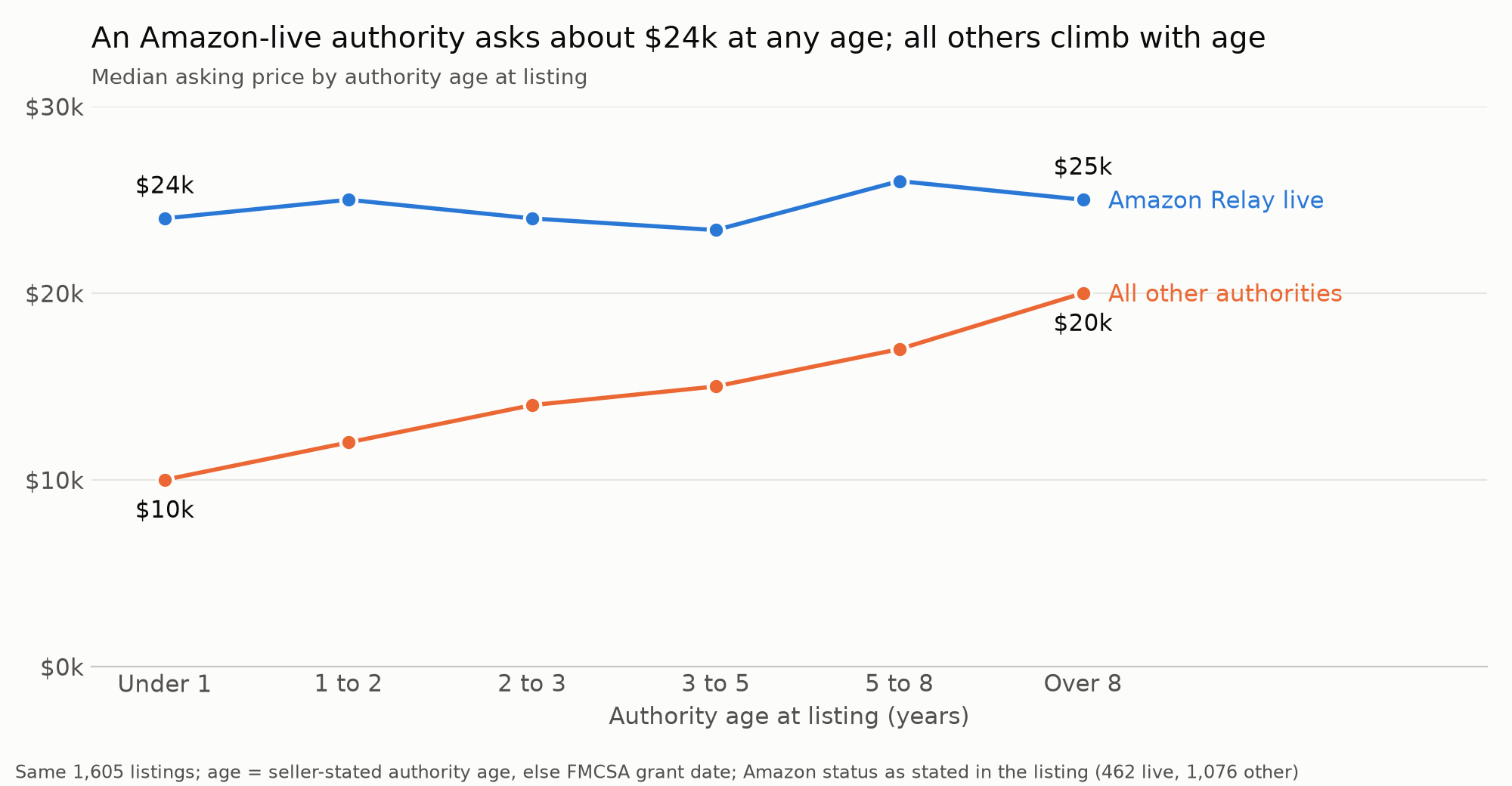
Split by Amazon status, the age curve disappears for live accounts. A live authority asks about $24,000 whether it is six months old or eight years old. For authorities without a live account, age is the main thing left to sell: the median rises from $10,000 under one year to $20,000 past eight. In this market, age is a proxy for "old enough to be trusted by brokers and Amazon." Once Amazon has already said yes, the proxy is redundant.
Inspections: a record beats a clean slate
You might expect a spotless authority with zero roadside inspections to command a premium. The market says the opposite. Authorities with no inspections before the listing ask a median of $12,000. Those with six to ten inspections ask $17,500. Beyond ten, the curve flattens at about $17,000.
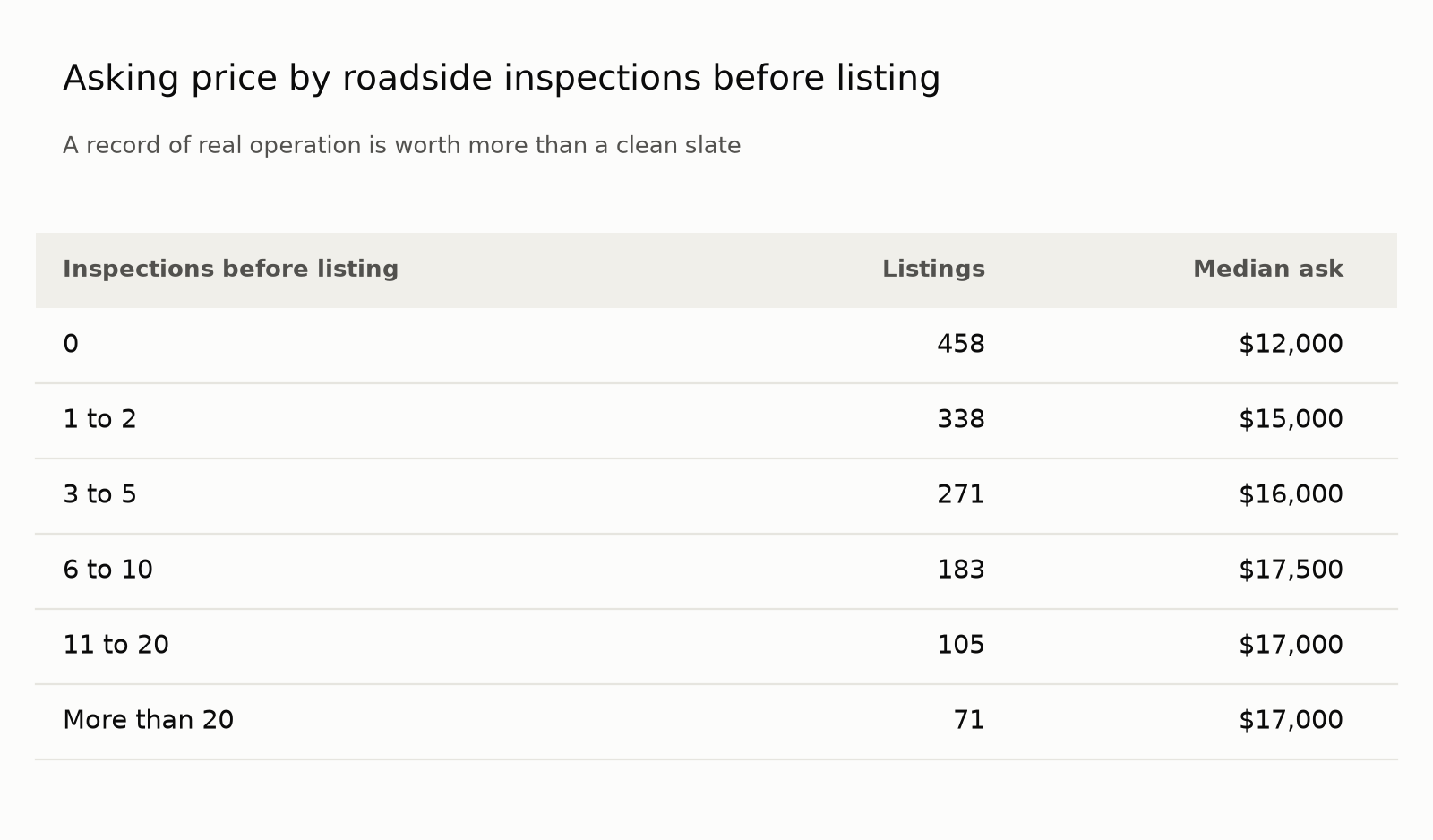
An inspection record is proof the authority has actually run freight. Zero inspections usually means the number was registered and parked, which is exactly the profile that brokers and Amazon screen for. Buyers pay for evidence of real operation, and they pay a little more for each doubling of it (about 2.5%), as long as the record is not bad. Out-of-service rates and crashes do appear in listings, but they are stated too rarely to measure their effect on price.
The package: what comes with the number
An authority rarely sells alone. Listings spell out what is bundled, and two items carry real money.
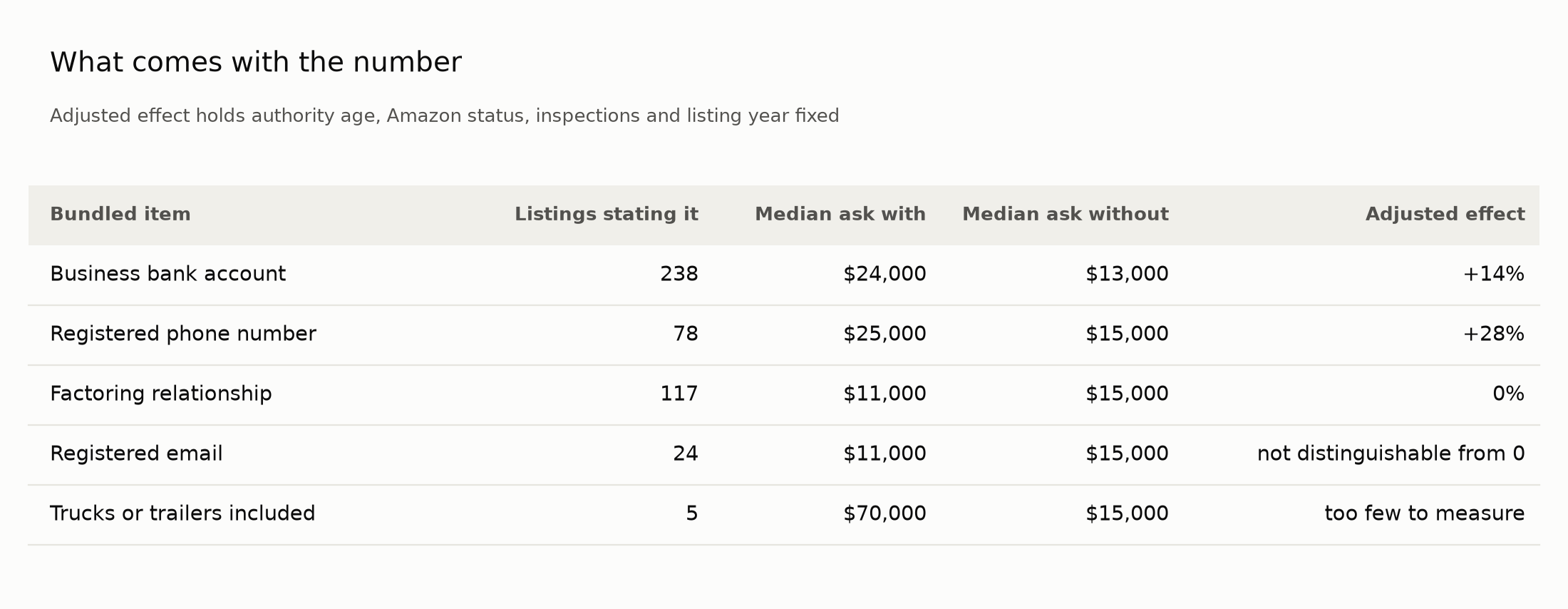
The bank account is the one to watch. A business account that has already cleared compliance with the authority attached saves the buyer weeks and a second identity check, so sellers who mention it ask $11,000 more. Part of that is because the same sellers tend to have Amazon-live authorities, which is why the adjusted effect is a smaller +14%. The phone number works the same way: it is the number brokers and Amazon have on file, so keeping it keeps the relationships.
Factoring is interesting for carrying no premium. A factoring agreement is easy to open and usually tied to the seller's business, not the authority, so buyers do not pay for it. The handful of listings that include trucks are a different product entirely, a small business sale rather than an authority sale, and they price accordingly.
Where the authority is registered
The home state shifts the ask by a few thousand dollars, with California, Indiana and North Carolina at the top and Texas and Arizona at the bottom. Texas is the largest market by volume and one of the cheapest.
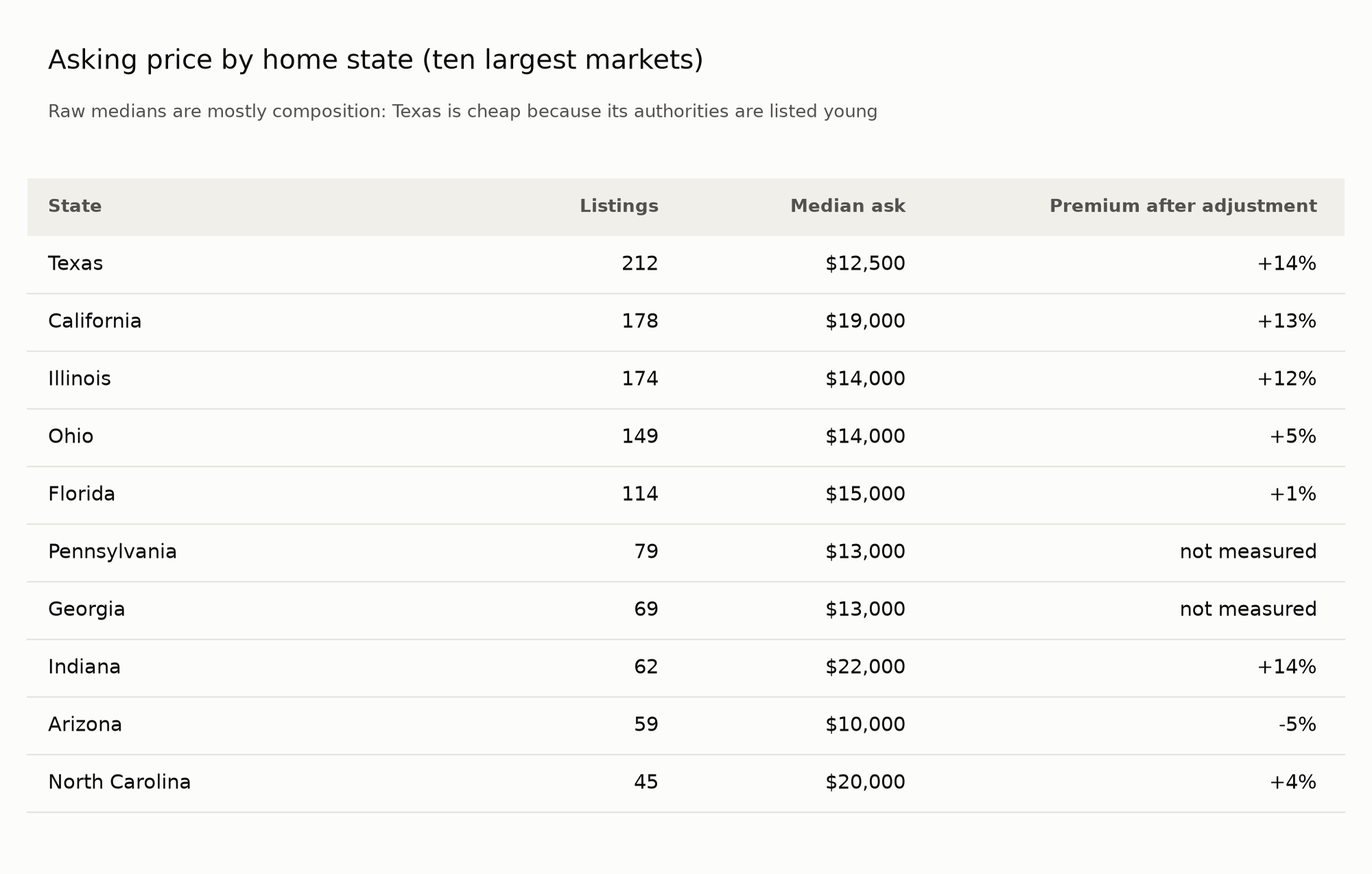
These are raw medians, and most of the spread is composition. Once age, Amazon status, inspections and listing date are held fixed, California, Texas, Indiana and Illinois all carry a premium of 12% to 14% over the rest of the country, while Arizona sits 5% below and Florida and Ohio are at par. Texas looks cheap in the raw table only because it is where new authorities are created and flipped young. The state you register in matters less than the listings suggest.
What does not move the price
Fleet size. The number of trucks the carrier reports to FMCSA has no relationship to the ask. The rank correlation between power units and price is 0.03, and the median is $15,000 to $17,000 in every size band from zero trucks to more than fifty. What is sold is the authority, not the equipment. Buyers bring their own trucks.
The rest of the FMCSA file. Insurance limits, insurer, cargo types, drivers, mileage, safety rating and the authority's revocation history explain almost nothing once age and inspection count are known. A model built only on FMCSA data predicts price barely better than guessing the median. Nearly all of the predictable variation lives in what the seller writes.
Where it was posted. Facebook listings ask about 7% more than Telegram listings for comparable authorities, inside the margin of error. The marketplace listings ask about 14% less. Channel is a weak signal next to Amazon status.
Factoring, highway setup, broker setups. Mentioned often, priced at zero.
All of it at once
The raw medians above overlap: Amazon-live authorities are also older and more often come with a bank account. A log-linear regression on 1,593 listings separates the effects. Each row is the percentage change in the ask for that factor, holding the others fixed, with a 90% interval from a bootstrap over listings.
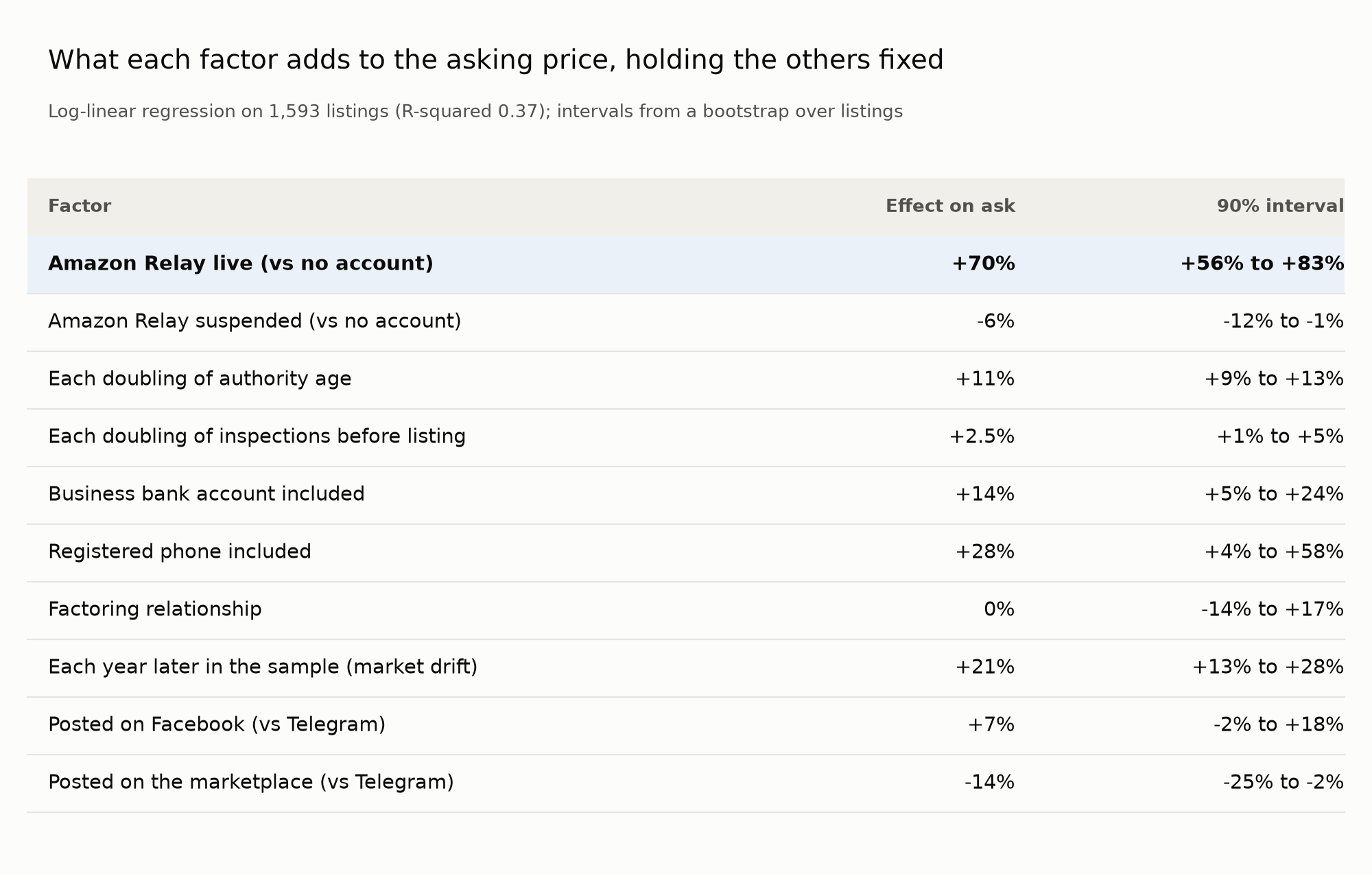
The model explains 37% of the variation in log price. A gradient-boosted model with the full listing text explains 54%, and the remainder is seller idiosyncrasy: the same authority described two ways gets two prices. The ordering, though, is stable across every model we tried. Amazon status first, by a wide margin. Then the market year. Then age, the phone and the bank account. Everything else is noise.
Method and caveats
What was measured. 1,605 for-sale listings of US motor carrier authorities with a stated asking price between $2,000 and $250,000, posted between January 2024 and October 2026. 72% came from Telegram channels, 19% from Facebook groups and 9% from an authority marketplace. Each listing was matched to a DOT number, and the carrier's FMCSA record (registration dates, inspections, fleet, insurance) was joined to it. Authority age is the seller's stated age where given, otherwise the FMCSA grant date; inspections are counted from FMCSA records up to the listing date.
Asking prices, not sale prices. Nothing here says what an authority sold for. The data is what sellers asked. Asks are sticky and often repeated across channels; we grouped reposts of the same listing so they count once in every comparison.
Associations, not causes. The regression holds other factors fixed statistically, not experimentally. An Amazon-live authority is also, on average, one that has been run carefully, and part of its premium may be paying for that.
Thin cells. Effects for phone numbers, trucks included and individual states rest on tens of listings, not hundreds, and carry the wide intervals to prove it.
Whole-business sales excluded. 44 listings above $250,000 were trucking companies sold with trucks, drivers and contracts. They are a different market and were left out.